ABERCROMBY [or Abercrombie], PATRICK (1656-c.1716), Scottish physician and antiquarian, was the third son of Alexander Abercromby of Fetterneir in Aberdeenshire, and brother of Francis Abercromby, who was created Lord Glasford by James II. He was born at Forfar in 1656 apparently of a Roman Catholic family. Intending to become a doctor of medicine he entered the university of St Andrews, where he took his degree of M.D. in 1685, but apparently he spent most of his youthful years abroad. It has been stated that he attended the university of Paris. The Discourse of Wit (1685), sometimes assigned to him, belongs to Dr David Abercromby.
On his return to Scotland, he is found practicing as a physician in Edinburgh, where, besides his professional duties, he gave himself with characteristic zeal to the study of antiquities. He was appointed physician to James II. in 1685, but the revolution deprived him of the post. Living during the agitations for the union of England and Scotland, he took part in the war of pamphlets inaugurated and sustained by prominent men on both sides of the Border, and he crossed swords with no less redoubtable a foe than Daniel Defoe in his Advantages of the Act of Security compared with those of the intended Union (Edinburgh, 1707), and A Vindication of the Same against Mr. De Foe (ibid.). A minor literary work of Abercromby’s was a translation of Jean de Beaugue’s Histoire de la guerre d’Ecosse (1556) which appeared in 1707.
But the work with which his name is permanently associated is 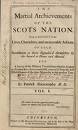 his
Martial Achievements of the Scots Nation, issued in two large folios,
vol. i. 1711, vol. ii. 1716. In the title-page and preface to vol. i.
he disclaims the ambition of being an historian, but in vol. ii., in
title-page and preface alike, he is no longer a simple biographer, but
an historian. Even though, read in the light of later researches, much
of the first volume must necessarily be relegated to the region of the
mythical, none the less was the historian a laborious and accomplished
reader and investigator of all available authorities, as well manuscript
as printed; while the roll of names of those who aided him includes
every man of note in Scotland at the time, from Sir Thomas Craig and Sir
George Mackenzie to Alexander Nisbet and Thomas Ruddiman. The date of
Abercromby’s death is uncertain. It has been variously assigned to
1715, 1716, 1720, and 1726, and it is usually added that he left a widow
in great poverty. The Memoirs of the Abercrombys, commonly attributed
to him, do not appear to have been published.
his
Martial Achievements of the Scots Nation, issued in two large folios,
vol. i. 1711, vol. ii. 1716. In the title-page and preface to vol. i.
he disclaims the ambition of being an historian, but in vol. ii., in
title-page and preface alike, he is no longer a simple biographer, but
an historian. Even though, read in the light of later researches, much
of the first volume must necessarily be relegated to the region of the
mythical, none the less was the historian a laborious and accomplished
reader and investigator of all available authorities, as well manuscript
as printed; while the roll of names of those who aided him includes
every man of note in Scotland at the time, from Sir Thomas Craig and Sir
George Mackenzie to Alexander Nisbet and Thomas Ruddiman. The date of
Abercromby’s death is uncertain. It has been variously assigned to
1715, 1716, 1720, and 1726, and it is usually added that he left a widow
in great poverty. The Memoirs of the Abercrombys, commonly attributed
to him, do not appear to have been published.
See Robert Chambers, Eminent Scotsmen, s.v.; William Anderson, Scottish Nation, s.v.; Alexander Chalmers, Biog. Dict., s.v.; George Chalmers, Life of Ruddiman; William Lee, Defoe.
Disclosure: We are independently owned and the opinions expressed here are our own. We do have advertisements with links to other sites on our pages, and may receive compensation when you click on one of those links and/or purchase something from one of those sites.
Copyright © D. J. McAdam· All Rights Reserved