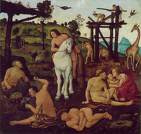
AEOLUS, in Greek mythology, according to Homer the son of Hippotes, god and father of the winds, and ruler of the island of Aeolia. In the Odyssey (x. I) he entertains Odysseus, gives him a favourable wind to help him on his journey, and a bag in which the unfavourable winds have been confined. Out of curiosity. or with the idea that it contains valuable treasures, Odysseus’ companions open the bag; the winds escape and drive them back to the island, whence Aeolus dismisses them with bitter reproaches. According to Virgil, Aeolus dwells on one of the Aeolian islands to the north of Sicily, Lipara or Strongyle (Stromboll), where he keeps the winds imprisoned in a vast cavern (Virgil, Aen. i. 52). Another genealogy makes him the son of Poseidon and Arne, granddaughter of Hippotes, and a descendant of Aeolus, king of Magnesia in Thessaly, the mythical ancestor of the tribe of the Aeolians (Diodorus iv. 67).
AEON, a term often used in Greek (aion) to denote an indefinite or infinite duration of time; and hence, by metonymy, a being that exists for ever. In the latter sense it was chiefly used by the Gnostic sects to denote those eternal beings or manifestations which emanated from the one incomprehensible and ineffable God.
*******
This is taken from 1911 encyclopedia.
Copyright © D. J. McAdam· All Rights Reserved