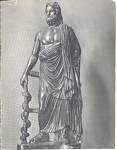
AESCULAPIUS (Gr. ‘Asklepios), the legendary Greek god of medicine, the son of Apollo and the nymph Coronis. Tricca in Thessaly and Epidaurus in Argolis disputed the honor of his birthplace, but an oracle declared in favor of Epidaurus. He was educated by the centaur Cheiron, who taught him the art of healing and hunting. His skill in curing disease and restoring the dead to life aroused the anger of Zeus, who, being afraid that he might render all men immortal, slew him with a thunderbolt (Apollodorus iii. 10; Pindar, Phthia, 3; Diod. Sic. iv. 71).
Homer mentions him as a skillful physician, whose sons, Machaon and Podalirius, are the physicians in the Greek camp before Troy (Iliad, ii. 731). Temples were erected to Aesculapius in many parts of Greece, near healing springs or on high mountains. The practice of sleeping (incubatio) in these sanctuaries was very common, it being supposed that the god effected cures or prescribed remedies to the sick in dreams. All who were healed offered sacrifice---especially a cock---and hung up votive tablets, on which were recorded their names, their diseases and the manner in which they had been cured. Many of these votive tablets have been discovered in the course of excavations at Epidaurus. Here was the god’s most famous shrine, and games were celebrated in his honor every five years, accompanied by solemn processions. Herodas (Mimes, 4) gives a description of one of his temples, and of the offerings made to him. His worship was introduced into Rome by order of the Sibylline books (293 B.C.), to avert a pestilence. The god was fetched from Epidaurus in the form of a snake and a temple assigned him on the island in the Tiber (Livy x. 47; Ovid, Metam. xv. 622). Aesculapius was a favorite subject of ancient artists. He is commonly represented standing, dressed in a long cloak, with bare breast; his usual attribute is a club-like staff with a serpent (the symbol of renovation) coiled round it. He is often accompanied by Telesphorus, the boy genius of healing, and his daughter Hygieia, the goddess of health. Votive reliefs representing such groups have been found near the temple of Aesculapius at Athens. The British Museum possesses a beautiful head of Aesculapius (or possibly Zeus) from Melos, and the Louvre a magnificent statue.
BIBLIOGRAPHY.—L. Dyer, The Gods in Greece (1891); Jane E. Harrison, Prolegomena to the Study of Greek Religion (1903); R. Caton, Examples and Ritual of A. at Epidaurus and Athens (1900); articles in Pauly-Wissowa’s Real-Encyclopadie, Roscher’s Lexikon der Mythologie; T. Panofka, Asklepios und die Asklepiaden (1846); Alice Welton, “The Cult of Asklepios,” in Cornell Studies in Classical Philology, iii. (New York, 1894); W. H. D. Rouse, Greek Votive Offerings (1902).
Disclosure: We are independently owned and the opinions expressed here are our own. We do have advertisements with links to other sites on our pages, and may receive compensation when you click on one of those links and/or purchase something from one of those sites.
Copyright © D. J. McAdam· All Rights Reserved