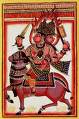
AGNI, the Hindu God of Fire, second only to Indra in the power and importance attributed to him in Vedic mythology.
His name is the first word of the first hymn of the Rig-veda: “Agni, I entreat, divine appointed priest of sacrifice.” The sacrifices made to Agni pass to the gods, for Agni is a messenger from and to the gods; but, at the same time, he is more than a mere messenger, he is an immortal, for another hymn runs: “No god indeed, no mortal is beyond the might of thee, the mighty One. . . .” He is a god who lives among men, miraculously reborn each day by the fire-drill, by the friction of the two sticks which are regarded as his parents; he is the supreme director of religious ceremonies and duties,and even has the power of influencing the lot of man in the future world. He is worshipped under a threefold form, fire on earth, lightning and the sun. His cult survived the metamorphosis of the ancient Vedic nature-worship into modern Hinduism, and there still are in India fire-priests (agnihotri) whose duty is to superintend his worship. The sacred fire-drill for procuring the temple-fire by friction—symbolic of Agni’s daily miraculous birth—is still used. In pictorial art Agni is always represented as red, two-faced, suggesting his destructive and beneficent qualities, and with three legs and seven arms.
Disclosure: We are independently owned and the opinions expressed here are our own. We do have advertisements with links to other sites on our pages, and may receive compensation when you click on one of those links and/or purchase something from one of those sites.
Copyright © D. J. McAdam· All Rights Reserved