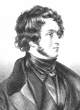
AINSWORTH, WILLIAM HARRISON (1805-1882), English novelist, son of Thomas Ainsworth, solicitor, was born at Manchester on the 4th of February 1805. He was educated at Manchester Grammar School and articled to the firm of which his father was a member, proceeding to London in 1824 to complete his legal training at the Inner Temple. At the age of twenty-one he married a daughter of John Ebers the publisher, and started in his father-in-law’s line of business. This, however, soon proved unprofitable and he decided to attempt literary work. A novel called Sir John Chiverton, in which he appears to have had a share, had attracted the praise of Sir Walter Scott, and this encouragement decided him to take up fiction as a career. In 1834 he published Rookwood, which had an immediate success, and thenceforth he was always occupied with the compilation of “historical” novels. He published about forty such stories, of which the best-known are Jack Sheppard (1839), The Tower Oglondon (1840), Guy Fawkes (1841), Old St Paul’s (1841) and Windsor Castle (1843). He edited Bentley’s Miscellany, in which Jack Sheppard was published as a serial, and in 1842 he became proprietor of Ainsworth’s Magazine. In 1853 it ceased to appear, and Ainsworth bought the New Monthly Magazine. He continued his literary activity until his death, but his later stories were less striking than the earlier ones. He died at Reigate on the 3rd of January 1882 and was buried at Kensal Green. Ainsworth had a lively talent for plot, and his books have many attractive qualities. The glorification of Dick Turpin in Rookwood, and of Jack Sheppard in the novel that bears his name, caused considerable outcry among straitlaced elders. In his later novels Ainsworth confined himself to heroes less open to criticism. His style was not without archaic affectation and awkwardness, but when his energies were aroused by a striking situation he could be brisk, vigorous and impressive. He did a great deal to interest the less educated classes in the historical romances of their country, and his tales were invariably instructive, clean and manly.
Disclosure: We are independently owned and the opinions expressed here are our own. We do have advertisements with links to other sites on our pages, and may receive compensation when you click on one of those links and/or purchase something from one of those sites.
Copyright © D. J. McAdam· All Rights Reserved