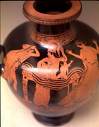
AMPHITRYON, in Greek mythology, son of Alcaeus, king of Tiryns in Argolis. Having accidentally killed his uncle Electryon, king of Mycenae, he was driven out by another uncle, Sthenelus. He fled with Alcmene, Electryon’s daughter, to Thebes, where he was cleansed from the guilt of blood by Creon, his maternal uncle, king of Thebes. Alcmene, who had been betrothed to Amphitryon by her father, refused to marry him until he had avenged the death of her brothers, all of whom except one had fallen in battle against the Taphians. It was on his return from this expedition that Electryon had been killed. Amphitryon accordingly took the field against the Taphians, accompanied by Creon, who had agreed to assist him on condition that he slew the Teumessian fox which had been sent by Dionysus to ravage the country.
The Taphians, however, remained invincible until Comaetho, the king’s daughter, out of love for Amphitryon cut off her father’s golden hair, the possession of which rendered him immortal. Having defeated the enemy, Amphitryon put Comaetho to death and handed over the kingdom of the Taphians to Cephalus. On his return to Thebes he married Alcmene, who gave birth to twin sons, Iphicles being the son of Amphitryon, Heracles of Zeus, who had visited her during Amphitryon’s absence. He fell in battle against the Minyans, against whom he had undertaken an expedition, accompanied by the youthful Heracles, to deliver Thebes from a disgraceful tribute. According to Euripides (Hercules Furens) he survived this expedition, and was slain by his son in his madness. Amphitryon was the title of a lost tragedy of Sophocles; the episode of Zeus and Alcmene forms the subject of comedies by Plautus and Moliere. From Moliere’s line “Le veritable Amphitryon est l’Amphitryon ou l’on dine” (Amphitryon, iii. 5), the name Amphitryon has come to be used in the sense of a generous entertainer, a good host.
Apollodorus ii. 4; Herodotus v. 59; Pausanias viii. 14, ix, 10, 11, 17; Hesiod, Shield, 1-56; Pindar, Pythia, ix. 81.
*******
Source: 1911 encyclopedia.
Copyright © D. J. McAdam· All Rights Reserved