Astrology in Shakespeare’s Plays
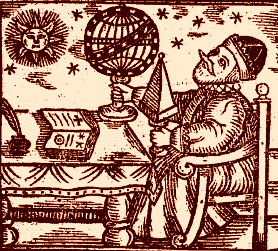 Do we need to understand astrology in order to understand Shakespeare? It would be difficult to fully comprehend today’s television shows and movies without some knowledge of our modern world. There are references in these scripts to various aspects of life in our times which someone from a different time would be unable to appreciate. The same is true with respect to understanding Shakespeare and his works – timeless they may be, but they do nevertheless reflect modes of thinking that are, at least in some cases, specific to his time, including a general interest in astrology. The following was written by C. J. S. Thompson.
The interest in astrology and the influence it exercised on the public mind in Shakespeare’s time is nowhere better illustrated than by some of the allusions he makes to astrology in his plays.
In King Lear, we find the aged King thus commenting on the belief of the influence of the stars on the destiny of man:
“And take upon’s the mystery of things,
As if we were God’s spies and we wear out
In a wall’d prison pacts and sects of great ones
That ebb and flow by the Moon.”
Gloster’s remark that, “These late eclipses in the sun and moon portend no good to us,” brings the reply from Edmund: “This is the excellent foppery of the world, that, when we are sick in fortune (often the surfeit of our own behavior) we make gaiety of our disasters the sun, the moon and the stars; as if we were by necessity, fools by heavenly compulsion, knaves, thieves, and treachers by spherical predominance, drunkards, liars, and adulterers by an enforced obedience of planetary influence, and all that we are evil in by a divine thrusting-on, and admirable evasion of a man to lay his goatish deposition to the charge of a star.
“My father compounded with my mother under the dragon’s tail and my nativity was under ursa major, so that it follows I am rough and lecherous.”[1]
There was a general belief that eclipses of either the sun or moon portended evil, to which Edmund refers in the following lines:
“I am thinking, brother, of a prediction I read the other day what should follow these eclipses.
Edgar. Do you busy yourself with that?
Edmund: I promise you the effects he writes of succeed unhappily.”
In the first part of Henry VI, there is the following reference to comets and their portent:
“Hung ye the heavens with black, yield day to night,
Comets, importing change of times and states,
Brandish your crystal tresses in the sky,
And with them scourge the bad revolting stars
That have consented to Henry’s death.”
In the same play, Talbot thus addresses his son:
“I did send for thee
To tutor thee in stratagems of war
But O malignant and ill-boding stars
Now thou art come to the feast of death,
A terrible and unavoided danger.”
In All’s Well That Ends Well, Helena and Monsieur Parolles have the following conversation:
Helena. “Monsieur Parolles, you were born under a charitable star.
Parolles. Under Mars, I.
Helena. I especially think under Mars.
Parolles. Why under Mars?
Helena. The wars have so kept you under, that you needs be born under Mars.
Parolles. When he was predominant?
Helena. When he was retrograde, I think, rather.”
The retrogression of a planet, which was said to have an oppressive effect, may also have been alluded to by the King in Hamlet, when he observes, “”It is most retrograde to our desire.”
In Romeo and Juliet, Romeo rebels against the astral destiny of his beloved, when he hears the news of her death:
“Is it even so? Then I defy you stars . . . “
Later, in the tomb, he exclaims:
“O here
Will I set up my everlasting rest
And shake the yoke of inauspicious stars from this world-wearied flesh.”
Conversely, in The Tempest, Prospero alluding to his lucky star says:
“I find my Zenith doth depend upon
A most auspicious star; whose influence,
If now I court not, but omit, my fortunes
Will ever after droop.”
Overall, we find Shakespeare knowledgeable about astrology, but also skeptical as to its efficacy. Perhaps the bard expressed this best not in any of his plays, but in Sonnet XIV:
Not from the stars do I my judgment pluck;
And yet methinks I have astronomy,
But not to tell of good or evil luck,
Of plagues, or dearths or seasons quality.
Nor can I fortune to brief minutes tell
Pointing to each his thunder, rain, and wind,
Or say with princes if it shall go well,
By oft predict that I in heaven find;
But from thine eyes my knowledge I desire,
And constant stars, in them I read such art
As truth and beauty shall together thrive.
If from thyself to store thou wouldst convert
Or else of thee this I prognosticate
Thy end is truth’s and beauty’s doom and date.
Notes:
1. There are a number of interesting things to comment upon in Gloster’s remarks. First, he makes the point, as most good astrologers do, that “the stars incline, they do not compel.” Second, he refers to both the time of his conception and the time of his birth as being astrologically significant. And third, he does not state what astrological sign he was born under, but rather which fixed star (or, in this case, constellation) he was born under.
2. It is difficult to know exactly what Shakespeare thought of astrology, but I have often been struck by the fact that his knowledge of it was fairly deep, and that this fact in and of itself might be a clue as to whether or not Bacon might have been the actual author of at least a portion of those works attributed to Shakespeare.