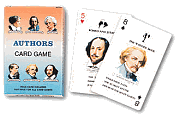
 Authors Card Game
The Game of Authors was originated in Salem and first played in the 1850s. It has been a great source of delight and information to many millions of players.
ORIGINAL FORM OF PLAY
THE OBJECT OF THE GAME is to collect complete sets of four cards each representing the works of the various Authors by calling for cards from other players.
THE PACK consists of thirteen sets of four cards each devoted to the works of each of the Authors represented. The small picture in the upper corner of each card simply symbolizes a character or feature in the author’s book or poem, and has no significance in play.
DEALING: One player is selected as first Dealer. He shuffles the cards thoroughly and deals the ENTIRE PACK one card at a time to each player (even if this gives some players one more card than others). Each player now arranges his hand so that the cards belonging to each author which he holds, are placed together for easy reference.
THE PLAY: The player at the left of the Dealer begins by calling from any other player for a card that will help him towards completing a set of any Author’s Works, any portion of which he holds.
The NAME of each card is the Title of a Book or Poem at the TOP OF THE CARDS. The three titles below give other works by that Author which it is necessary for a player to hold in order to complete a set.
If he obtains the card he calls for he then calls for another card, either from the same or any other player. When he fails, the turn to play passes to the left.
EXAMPLE: If a player holds one or more William Shakespeare cards – let us say – “Hamlet” and “Julius Caesar”, he may in his turn call for “The Tempest” from one of the other players and if he receives that card, he may then call for “Romeo and Juliet” from the same or any other player. THE FORM OF CALLING is “I would like William Shakespeare’s ‘Romeo and Juliet’ from Mr. Blank”.
When a player completes a Set of four cards all of the same Author, he SHOWS the four cards, and then places them face down near him and continues play.
A player may not call for a card of a set when he does not hold at least one card of that author.
If a player calls for a card which he ALREADY HOLDS, he must surrender all the cards of that Author which he holds to the player from whom he has in error made the call.
When a player runs out of cards he ceases play, the other players continuing if they have any cards left.
THE WINNER is the player at the end of the game who has formed the greatest number of Complete Sets of Four cards each. (If two players have formed the same number of Sets, another game is played and if either of the players Wins that game, he is also accorded the first game, which otherwise remains a Draw.)
POPULAR “DRAWING-PILE” GAME
For Two, Three, Four or Five Players
In this method of playing Authors, FOUR CARDS are dealt face-down, to each player the remainder of the pack being placed face-down in the Center of the Table as a “DRAWING PILE”. The player at the Dealer’s left begins by calling on any other player for a card that will help him complete a Set of which he already holds one or more cards.
If the player called upon has the desired card, he gives it to the Caller who continues calling until he fails. THE CALLER THEN DRAWS a card FROM THE TOP OF THE DRAWING PILE. If he draws the card he called for, he shows the card and continues calling from other players until unsuccessful. He then Draws another card. When he fails either by calling or drawing to obtain the card called for, the turn passes to the left.
THE WINNER is the player who forms the greatest number of complete sets of four cards each.
Other Authors Card Games
The success of Authors has given rise to a whole series of Authors card games – all are played in the same manner. Currently available, in addition to the original Authors game, are the following:
- American Authors
- American Women Authors
- Baseball Legends
- Children’s Authors
- Composers
- Explorers
- Inventors
Some Additional Notes
The first Game of Authors was published by G. M. Whipple & A. A. Smith of Salem, Massachusetts in 1861.
The Game of Authors was published by Parker Brothers (also, at the time, of Salem, Massachusetts) in 1897.
The Game of Philately? We recently came across this tantalizing tidbit of information in the February, 1893 issue of The Eastern Philatelist:
“At last Philately has a game of its own, Lieut. Powell Coleman of Salisbury, Mo., having invented a philatelic game which is played very similarly to the well-known game of authors. There are 48 cards in the pack, twelve sets of four each, and on each card is an illustration of a stamp with a description of three others which constitute the set. No doubt they will meet with a ready sale among young collectors.”