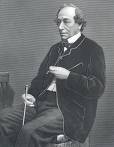
BEACONSFIELD, BENJAMIN DISRAELI, 1ST EARL of (1804-1881). —Statesman and novelist, was the son of Isaac Disraeli. Belonging to a Jewish family settled first in Spain, whence in the 15th century they migrated to Italy, he was b. in London in 1804 and privately ed. His father destined him for the law, and he was articled to a solicitor. The law was, however, uncongenial, and he had already begun to write. After some journalistic work, he brought himself into general notice by the publication, in 1827, of his first novel, Vivian Grey, which created a sensation by its brilliance, audacity, and slightly veiled portraits of living celebrities. After producing a Vindication of the British Constitution, and some political pamphlets, he followed up his first success by a series of novels, The Young Duke (1831), Contarini Fleming (1832), Alroy (1833), Venetia and Henrietta Temple (1837). During the same period he had also written The Revolutionary Epic and three burlesques, Ixion, The Infernal Marriage, and Popanilla. These works had gained for him a brilliant, if not universally admitted, place in literature. But his ambition was by no means confined to literary achievement; he aimed also at fame as a man of action. After various unsuccessful attempts to enter Parliament, in which he stood, first as a Radical, and then as a Tory, he was in 1837 returned for Maidstone, having for his colleague Mr. Wyndham Lewis, whose widow he afterwards married.
For some years after entering on his political career, Disraeli ceased to write, and devoted his energies to parliamentary work. His first speech was a total failure, being received with shouts of laughter, but with characteristic courage and perseverance he pursued his course, gradually rose to a commanding position in parliament and in the country, became leader of his party, was thrice Chancellor of the Exchequer, 1852, 1858-59, and 1866-68, in which last year he became Prime Minister, which office he again held from 1874 till 1880.
To return to his literary career, in 1844 he had pub. Coningsby, followed by Sybil (1845), and Tancred (1847), and in 1848 he wrote a life of Lord G. Bentinck, his predecessor in the leadership of the Protectionist party. His last novels were Lothair (1870), and Endymion (1880). He was raised to the peerage as Earl of Beaconsfield in 1876, and was a Knight of the Garter. In his later years he was the intimate friend as well as the trusted minister of Queen Victoria. The career of Disraeli is one of the most remarkable in English history. With no family or political influence, and with some personal characteristics, and the then current prejudices in regard to his race to contend with, he rose by sheer force of will and intellect to the highest honours attainable in this country. His most marked qualities were an almost infinite patience and perseverance, indomitable courage, a certain spaciousness of mind, and depth of penetration, and an absolute confidence in his own abilities, aided by great powers of debate rising occasionally to eloquence. Though the object, first of a kind of contemptuous dislike, then of an intense opposition, he rose to be universally regarded as, at all events, a great political force, and by a large part of the nation as a great statesman. As a writer he is generally interesting, and his books teem with striking thoughts, shrewd maxims, and brilliant phrases which stick in the memory. On the other hand he is often artificial, extravagant, and turgid, and his ultimate literary position is difficult to forecast.
Lives by Froude (1890), Hitchman (1885), see also Dictionary of Nat. Biog. etc.
Disclosure: We are independently owned and the opinions expressed here are our own. We do have advertisements with links to other sites on our pages, and may receive compensation when you click on one of those links and/or purchase something from one of those sites.
Copyright © D. J. McAdam· All Rights Reserved