[This is taken from William Blades' The Enemies of Books, originally published in 1888.]
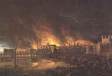
THERE are many of the forces of Nature which tend to injure Books; but among them all not one has been half so destructive as Fire. It would be tedious to write out a bare list only of the numerous libraries and bibliographical treasures which, in one way or another, have been seized by the Fire-king as his own. Chance conflagrations, fanatic incendiarism, judicial bonfires, and even household stoves have, time after time, thinned the treasures as well as the rubbish of past ages, until, probably, not one thousandth part of the books that have been are still extant. This destruction cannot, however, be reckoned as all loss; for had not the “cleansing fires” removed mountains of rubbish from our midst, strong destructive measures would have become a necessity from sheer want of space in which to store so many volumes.
Before the invention of Printing, books were comparatively scarce; and, knowing as we do, how very difficult it is, even after the steam-press has been working for half a century, to make a collection of half a million books, we are forced to receive with great incredulity the accounts in old writers of the wonderful extent of ancient libraries.
The historian Gibbon, very incredulous in many things, accepts without questioning the fables told upon this subject. No doubt the libraries of MSS. collected generation after generation by the Egyptian Ptolemies became, in the course of time, the most extensive ever then known; and were famous throughout the world for the costliness of their ornamentation, and importance of their untold contents. Two of these were at Alexandria, the larger of which was in the quarter called Bruchium. These volumes, like all manuscripts of those early ages, were written on sheets of parchment, having a wooden roller at each end so that the reader needed only to unroll a portion at a time. During Caesar’s Alexandrian War, B.C. 48, the larger collection was consumed by fire and again burnt by the Saracens in A.D. 640. An immense loss was inflicted upon mankind thereby; but when we are told of 700,000, or even 500,000 of such volumes being destroyed we instinctively feel that such numbers must be a great exaggeration. Equally incredulous must we be when we read of half a million volumes being burnt at Carthage some centuries later, and other similar accounts.
Among the earliest records of the wholesale destruction of Books is that narrated by St. Luke, when, after the preaching of Paul, many of the Ephesians “which used curious arts brought their books together, and burned them before all men: and they counted the price of them, and found it 50,000 pieces of silver” (Acts xix, 19). Doubtless these books of idolatrous divination and alchemy, of enchantments and witchcraft, were righteously destroyed by those to whom they had been and might again be spiritually injurious; and doubtless had they escaped the fire then, not one of them would have survived to the present time, no MS.of that age being now extant. Nevertheless, I must confess to a certain amount of mental disquietude and uneasiness when I think of books worth 50,000 denarii—or, speaking roughly, say £18,750, of our modern money being made into bonfires. What curious illustrations of early heathenism, of Devil worship, of Serpent worship, of Sun worship, and other archaic forms of religion; of early astrological and chemical lore, derived from the Egyptians, the Persians, the Greeks; what abundance of superstitious observances and what is now termed “Folklore”; what riches, too, for the philological student, did those many books contain, and how famous would the library now be that could boast of possessing but a few of them.
The ruins of Ephesus bear unimpeachable evidence that the City was very extensive and had magnificent buildings. It was one of the free cities, governing itself. Its trade in shrines and idols was very extensive, being spread through all known lands. There the magical arts were remarkably prevalent, and notwithstanding the numerous converts made by the early Christians, the ‘Efesia grammata,' or little scrolls upon which magic sentences were written, formed an extensive trade up to the fourth century. These “writings” were used for divination, as a protection against the “evil eye,” and generally as charms against all evil.They were carried about the person, so that probably thousands of them were thrown into the flames by St. Paul’s hearers when his glowing words convinced them of their superstition.
Imagine an open space near the grand Temple of Diana, with fine buildings around. Slightly raised above the crowd, the Apostle, preaching with great power and persuasion concerning superstition, holds in thrall the assembled multitude. On the outskirts of the crowd are numerous bonfires, upon which Jew and Gentile are throwing into the flames bundle upon bundle of scrolls, while an Asiarch with his peace-officers looks on with the conventional stolidity of policemen in all ages and all nations. It must have been an impressive scene, and many a worse subject has been chosen for the walls of the Royal Academy.
Books in those early times, whether orthodox or heterodox, appear to have had a precarious existence. The heathens at each fresh outbreak of persecution burnt all the Christian writings they could find, and the Christians, when they got the upper hand, retaliated with interest upon the pagan literature. The Mohammedan reason for destroying books—“If they contain what is in the Koran they are superfluous, and if they contain anything opposed to it they are immoral,” seems, indeed, mutatis mutandis, to have been the general rule for all such devastators.
The Invention of Printing made the entire destruction of any author’s works much more difficult, so quickly and so extensively did books spread through all lands. On the other hand, as books multiplied, so did destruction go hand in hand with production, and soon were printed books doomed to suffer in the same penal fires, that up to then had been fed on MSS. only.
At Cremona, in 1569, 12,000 books printed in Hebrew were publicly burnt as heretical, simply on account of their language; and Cardinal Ximenes, at the capture of Granada, treated 5,000 copies of the Koran in the same way.
At the time of the Reformation in England a great destruction of books took place. The antiquarian Bale, writing in 1587, thus speaks of the shameful fate of the Monastic libraries:--
“A greate nombre of them whyche purchased those superstycyouse mansyons (Monasteries) reserved of those librarye bookes some to serve their jakes, some to scoure theyr candelstyckes, and some to rubbe theyr bootes. Some they solde to the grossers and sope sellers, and some they sent over see to yeS booke bynders, not in small nombre, but at tymes whole shyppes full, to yeS, wonderynge of foren nacyons. Yea yeS. Universytees of thys realme are not alle clere in thys detestable fact. But cursed is that bellye whyche seketh to be fedde with suche ungodlye gaynes, and so depelye shameth hys natural conterye. I knowe a merchant manne, whych shall at thys tyme be namelesse, that boughte yeS contentes of two noble lybraryes for forty shyllynges pryce: a shame it is to be spoken. Thys stuffe hathe heoccupyed in yeS stede of greye paper, by yeS, space of more than these ten yeares, and yet he bathe store ynoughe for as manye years to come. A prodygyous example is thys, and to be abhorred of all men whyche love theyr nacyon as they shoulde do. The monkes kepte them undre dust, yeS, ydle-headed prestes regarded them not, theyr latter owners have most shamefully abused them, and yeS covetouse merchantes have solde them away into foren nacyons for moneye.”
How the imagination recoils at the idea of Caxton’s translation of the Metamorphoses of Ovid, or perhaps his “Lyf of therle of Oxenforde,” together with many another book from our first presses, not a fragment of which do we now possess, being used for baking “pyes.”
At the Great Fire of London in 1666, the number of books burnt was enormous. Not only in private houses and Corporate and Church libraries were priceless collections reduced to cinders, but an immense stock of books removed from Paternoster Row by the Stationers for safety was burnt to ashes in the vaults of St. Paul’s Cathedral.
Coming nearer to our own day, how thankful we ought to be for the preservation of the Cotton Library. Great was the consternation in the literary world of 1731 when they heard of the fire at Ashburnham House, Westminster, where, at that time, the Cotton MSS. were deposited. By great exertions the fire was conquered, but not before many MSS. had been quite destroyed and many others injured. Much skill was shown in the partial restoration of these books, charred almost beyond recognition; they were carefully separated leaf by leaf, soaked in a chemical solution, and then pressed flat between sheets of transparent paper. A curious heap of scorched leaves, previous to any treatment, and looking like a monster wasps’ nest, may be seen in a glass case in the MS. department of the British Museum, showing the condition to which many other volumes had been reduced.
Just a hundred years ago the mob, in the “Birmingham Riots,” burnt the valuable library of Dr. Priestley, and in the “Gordon Riots” were burnt the literary and other collections of Lord Mansfield, the celebrated judge, he who had the courage first to decide that the Slave who reached the English shore was thenceforward a free man. The loss of the latter library drew from the poet Cowper two short and weak poems. The poet first deplores the destruction of the valuable printed books, and then the irretrievable loss to history by the burning of his Lordship’s many personal manuscripts and contemporary documents.
“Their pages mangled, burnt and torn,
The loss was his alone;
But ages yet to come shall mourn
The burning of his own.”
The second poem commences with the following doggerel:--
“When Wit and Genius meet their doom
In all-devouring Flame,
They tell us of the Fate of Rome
And bid us fear the same.”
The much finer and more extensive library of Dr. Priestley was left unnoticed and unlamented by the orthodox poet, who probably felt a complacent satisfaction at the destruction of heterodox books, the owner being an Unitarian Minister.
The magnificent library of Strasbourg was burnt by the shells of the German Army in 1870. Then disappeared for ever, together with other unique documents, the original records of the famous law-suits between Gutenberg, one of the first Printers, and his partners, upon the right understanding of which depends the claim of Gutenberg to the invention of the Art. The flames raged between high brick walls, roaring louder than a blast furnace. Seldom, indeed, have Mars and Pluto had so dainty a sacrifice offered at their shrines; for over all the din of battle, and the reverberation of monster artillery, the burning leaves of the first printed Bible and many another priceless volume were wafted into the sky, the ashes floating for miles on the heated air, and carrying to the astonished countryman the first news of the devastation of his Capital.
When the Offor Collection was put to the hammer by Messrs Sotheby and Wilkinson, the well-known auctioneers of Wellington Street, and when about three days of the sale had been gone through, a Fire occurred in the adjoining house, and, gaining possession of the Sale Rooms, made a speedy end of the unique Bunyan and other rarities then on show. I was allowed to see the Ruins on the following day, and by means of a ladder and some scrambling managed to enter the Sale Room where parts of the floor still remained. It was a fearful sight those scorched rows of Volumes still on the shelves; and curious was it to notice how the flames, burning off the backs of the books first, had then run up behind the shelves, and so attacked the fore-edge of the volumes standing upon them, leaving the majority with a perfectly untouched oval centre of white paper and plain print, while the whole surrounding parts were but a mass of black cinders. The salvage was sold in one lot for a small sum, and the purchaser, after a good deal of sorting and mending and binding placed about 1,000 volumes for sale at Messrs. Puttick and Simpson’s in the following year.
So, too, when the curious old Library which was in a gallery of the Dutch Church, Austin Friars, was nearly destroyed in the fire which devastated the Church in 1862, the books which escaped were sadly injured. Not long before I had spent some hours there hunting for English Fifteenth-century Books, and shall never forget the state of dirt in which I came away. Without anyone to care for them, the books had remained untouched for many a decade-damp dust, half an inch thick, having settled upon them! Then came the fire, and while the roof was all ablaze streams of hot water, like a boiling deluge, washed down upon them. The wonder was they were not turned into a muddy pulp. After all was over, the whole of the library, no portion of which could legally be given away, was lent for ever to the Corporation of London. Scorched and sodden, the salvage came into the hands of Mr. Overall, their indefatigable librarian. In a hired attic, he hung up the volumes that would bear it over strings like clothes, to dry, and there for weeks and weeks were the stained, distorted volumes, often without covers, often in single leaves, carefully tended and dry-nursed. Washing, sizing, pressing, and binding effected wonders, and no one who to-day looks upon the attractive little alcove in the Guildhall Library labelled “Bibliotheca Ecclesiae Londonino-Belgiae” and sees the rows of handsomely-lettered backs, could imagine that not long ago this, the most curious portion of the City’s literary collections, was in a state when a five-pound note would have seemed more than full value for the lot.
Disclosure: We are independently owned and the opinions expressed here are our own. We do have advertisements with links to other sites on our pages, and may receive compensation when you click on one of those links and/or purchase something from one of those sites.
Copyright © D. J. McAdam· All Rights Reserved