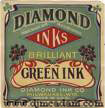
[This is taken from David N. Carvalho's Forty Centuries of Ink, originally published in 1904.]
IMPORTANCE OF HONEST INK MANUFACTURE—ABSENCE OF INFORMATION AS TO NAMES OF MOST ANCIENT INK MAKERS,--WHERE TO LOOK FOR ANCIENT INK—THEIR PHENOMENAL IDENTITY—INK AND PAPER AS ASIATIC INVENTIONS ENTER EUROPE IN THE TWELFTH CENTURY—BOTH IN GENERAL USE IN THE FOURTEENTH CENTURY—MONKS AND SCRIBES AS THEIR OWN INK MANUFACTURERS—MODERN INDUSTRY OF INK BEGINS IN 1625--ITS GROWTH AND PRESENT SITUATION—THE GENERAL IGNORANCE OF THE SUBJECT—INK INDUSTRY IN THE EIGHTEENTH CENTURY—THE FIRST PIONEERS ABROAD AND THOSE AT HOME—OBSERVATIONS RESPECTING INK PHENOMENA OF THE PAST EIGHTY YEARS—WHAT SOME INK MAKERS SAY ABOUT IT—LITTLE DEMAND FOR PURE INKS—SOME SKETCHES OF THE LEADING INK MANUFACTURERS OF THE WORLD—ESTIMATION OF QUANTITY OF INK MADE IN THE UNITED STATES—THE “LIFE” OF A MARK MADE WITH ORDINARY WRITING FLUID—ESTIMATION OF MOST INKS BY PROFESSORS BAIRD AND MARKOE—FORMULA OF THE OFFICIAL INK OF THE STATE OF MASSACHUSETTS—VIEWS OF SOME PROMINENT INK MANUFACTURERS ABOUT SUCH INK—SOME COMMERCIAL NAMES BESTOWED ON DIFFERENT INKS—THE 200 OR MORE NAMES OF INK MANUFACTURERS OF THE NINETEENTH CENTURY.
The consideration of the effect of the use of ink upon civilization from primitive times to the present, as we have seen, offers a most suggestive field and certifies to the importance of the manufacture of honest inks as necessary to the future enlightenment of society. That it has not been fully understood or even appreciated goes without saying; a proper generalization becomes possible only in the light of corroborative data and the experiences of the many.
History has not given us the names of ancient ink makers; but we can believe there must have been during a period of thousands of years a great many, and that the kinds and varieties of inks were without number. Those inks which remain to us are to be found only as written with on ancient MSS.; they are of but few kinds, and in composition and appearance preserve a phenomenal identity, though belonging to countries and epochs widely separated. This identity leads to the further conclusion that ink making must have been an industry at certain periods, overlooked by careful compounders who distributed their wares over a vast territory.
“Gall” ink and “linen” paper as already stated are Asiatic inventions. Both of them seem to have entered Europe by way of Arabia, “hand in hand” at the very end of the eleventh or beginning of the twelfth centuries and for the next two hundred years, notwithstanding the fact that chemistry was almost an unknown science and the secrets of the alchemists known only to the few, this combination gradually came into general vogue.
In the fourteenth century we find one or both of them more or less substituted for “Indian” ink, parchment, vellum and “cotton” paper. It was, however, the monks and scribes who manufactured for their own and assistants’ use “gall” ink, just as they had been in the habit of preparing “Indian” ink when required, which so far as known was not always a commodity.
As an industry it can be said to have definitely begun when the French government recognized the necessity for one, A. D. 1625, by giving a contract for “a great quantity of ‘gall ink’ to Guyot,” who for this reason seems to occupy the unique position of the father of the modern ink industry.
Ink manufacture as a growing industry heretofore and to a large extent at present, occupies a peculiarly anomalous situation. Other industries follow the law of evolution which may perhaps bear criticism; but the ink industry follows none, nor does it even pretend to possess any.
Thousands are engaged in its pursuit, few of whom understand either ink chemistry or ink phenomena. The consumer knows still less, and with blind confidence placidly accepts nondescript compounds labeled “Ink,” whether purchased at depots or from “combined” itinerant manufacturing peddlers and with them write or sign documents which some day may disturb millions of property. And yet in a comparative sense it has outpaced all other industries.
With the commencement of the eighteenth century we find the industry settling in Dresden, Chemnitz, Amsterdam, Berlin, Elberfield and Cologne. Still later in London, Vienna, Paris, Edinburgh and Dublin, and in the first half of the nineteenth century in the United States, it had begun to make considerable progress.
Among the first pioneers of the later modern ink industry abroad, may be mentioned the names of Stephens, Arnold, Blackwood, Ribaucourt, Stark, Lewis, Runge, Leonhardi, Gafford, Bottger, Lipowitz, Geissler, Jahn, Van Moos, Ure, Schmidt, Haenle, Elsner, Bossin, Kindt, Trialle, Morrell, Cochrane, Antoine, Faber, Waterlous, Tarling, Hyde, Thacker, Mordan, Featherstone, Maurin, Triest and Draper.
In the period covered by the nineteenth century at home, the legitimate industry included over 300 ink makers. Those best known are Davids, Maynard and Noyes, Carter, Underwood, Stafford, Moore, Davis, Thomas, Sanford, Barnes, Morrell, Walkden, Lyons, Freeman, Murray, Todd, Bonney, Pomeroy, Worthington, Joy, Blair, Cross, Dunlap, Higgins, Paul, Anderson, Woodmansee, Delang, Allen, Stearns, Gobel, Wallach, Bartram, Ford and Harrison.
The ink phenomena included in the past eighty years has demonstrated a continuing retrogression in ink manufacture and a consequent deterioration of necessary ink qualities. When the attention of some ink makers are addressed to these sad facts, they attribute them, either to the demand of the public for an agreeable color and a free flowing ink, or to an inability to compete with inferior substitutes, which have flooded the market since the discovery of the coal tar colors; they have been compelled to depart from old and tried formulas, in the extravagant use (misuse) of the so-called “added” color.
An exceptional few of the older firms continue to catalogue unadulterated “gall” inks; but the demand for them except in localities where the law COMPELS their employment, is only little.
Interesting deductions can be made from the accompanying brief sketches of the leading ink manufacturers of the world.
The “Arnold” brand of inks possesses a worldwide reputation, although not always known by that name, beginning A. D. 1724 under the style of R. Ford, and continuing until 1772, when the firm name was changed to William Green & Co. In 1809 it became J. & J. Arnold, who were succeeded in 1814 by Pichard and John Arnold, the firm name by which it is known at the present day. This last named concern located at 59 Barbican, on the site of the old City Hall in London, and later moved to their present address, No. 155 Aldersgate street. The inks made by the “fathers” of the firm were “gall” inks WITHOUT “added” color. At the commencement of the nineteenth century we find them making tanno-gallate of iron inks to which were added extractive matter from logwood and other materials to form thick fluids for shipment to Brazil, India and the countries where brushes or reeds were used as writing instruments. For the more civilized portions of the world similar inks but of an increased fluidity were supplied, that the quill pens might be employed. The demands for still more fluid inks which would permit the use of steel pens, resulted in the modern blue-black chemical writing fluid, the “added” blue portion being indigo in some form. It was first put on the market in 1830. They manufacture over thirty varieties of ink, but only one real “gall” ink without “added” color.
In the early part of May, 1824, Thaddeus Davids started his ink factory at No. 222 William street, New York City. His first and best effort was a strictly pure tanno-gallate of iron ink, which he placed on the market in 1827 under the name of “Steel Pen Ink,” guaranteed to write black and to possess “record” qualities. In 1833 he made innovations following the lines laid down by Arnold and also commenced the manufacture of a chemical writing fluid, with indigo for “added” color. Many more “added” colors were employed at different periods, like logwood and fustic, with the incorporation of sugar, glucose, etc. In the early fifties the cheap grades of logwood ink after the formula of Runge (1848) and which cost about four cents per gallon was marketed, principally for school purposes; it was never satisfactory, becoming thick and “color fading.” Mr. Davids made many experiments with “alizarin” inks in the early sixties but did not consider them valuable enough to put on the market. In 1875 the firm introduced violet ink made from the aniline color of that name. Experimentations in 1878 with the insoluble aniline blacks and vanadium were unsuccessful; but the soluble aniline black (blue-black) known as nigrosine they used and still use in various combinations. During this long period their establishments have been in different locations. From No. 222 William street it was changed to Eighth street, with the office at No. 26 Cliff street. In 1854 the works were removed to New Rochelle, Westchester county, N. Y. In 1856 the firm name was Thaddeus Davids and Co., Mr. George Davids having been admitted as a partner and their warehouse and offices at this time were located at Nos. 127 and 129 William street, where a business of enormous proportions, which includes the manufacture of thirty-three inks and other products, is still carried on at the present day under the name and style of “Thaddeus Davids, Co.” The old “Davids’ Steel Pen Ink” continues to be manufactured from the original formula and is the only tanno-gallate of iron ink they make, WITHOUT “added” color.
The Paris house of “Antoine” as manufacturers of writing inks dates from 1840. They are best known as the makers of the French copying ink, of a violet-black color, made from logwood, which was first put on the market in 1853 under the name of Encres Japonaise. In 1860 an agency was established in New York City. They make a large variety of writing inks but do not offer for sale a tanno-gallate of iron ink without “added” color.
“Carter’s” inks came into notoriety in 1861, by the introduction of a “combined writing and copying ink,” of the gall and iron type and included “added “ color. It was the first innovation of this character. At the end of the Civil War, John W. Carter of Boston, who had been an officer of the regular army, purchased an interest in the business, associating with himself Mr. J. P. Dinsmore of New York, the firm being known as Carter, Dinsmore & Co., Boston, Mass. In 1895 Mr. Carter died and Mr. Dinsmore retired from the business. The firm was then incorporated under the style of “The Carter’s Ink Co.” They do an immense business and make all kinds of ink. Of the logwoods, “Raven Black” is best known. When the state of Massachusetts in 1894 decided that recording officers must use a “gall” ink made after an official formula, they competed with other manufacturers for the privilege of supplying such an ink and won it. They do not offer for sale, however, “gall” ink WITHOUT added color. Their laboratories are magnificently equipped; the writer has had the pleasure of collaborating with several of their expert chemists.
The “Fabers,” who date back to the year 1761, are known all over the world as lead pencil makers. They also manufacture many inks and have done so since 1881, when they built now factories at Noisy-le-Sac, near Paris. Blue-black and violet-black writing and copying inks of the class made by the “Antoines” are the principal kinds. They do not offer for sale, tanno-gallate of iron ink without “added” color. A branch house in New York City has remained since 1843.
“Stafford’s” violet combined writing and copying ink was first placed on the New York market in 1869, though it was in 1858 that Mr. S. S. Stafford, the founder of the house, began the manufacture of inks, which he has continued to do to the present day. His chemical writing fluids are very popular, but he does not make a tanno-gallate of iron ink without “added” color, for the trade.
Charles M. Higgins of Brooklyn, N. Y., in 1880 commenced the manufacture of “carbon” inks for engrossing, architectural and engineering purposes, and has succeeded in producing an excellent liquid “Indian” ink, which will not lose its consistency if kept from the air. It can also be used as a writing ink, if thinned down with water. He does not make a tanno-gallate of iron ink without “added” color.
Maynard and Noyes, whose inks were much esteemed in this section for over fifty years, is no longer in business, as is the case with many others well known during the first half of the nineteenth century.
The enormous quantities of ink of every color, quality and description made in the United States almost surpasses belief. It is said that the output for home consumption alone exceeds twelve millions of gallons per annum, and for export three thousand gallons per annum.
It is very safe to affirm that less than 1/50 of 1 per cent of this quantity represents a tanno-gallate of iron ink WITHOUT “added” color. Most colored inks and “gall” ones which possess “added” color if placed on paper under ordinary conditions will not be visible a hundred years hence.
This statement of mine might be considered altogether paradoxical were it not for associated evidential facts, which by proving themselves have established its correctness and truth. To repeat one of them is to refer to the report of Professors Baird and Markoe, who examined for the state of Massachusetts all the commercial inks on the market at that time.
“As a conclusion, since the great mass of inks on the market are not suitable for records, because of their lack of body and because of the quantity of unstable color which they contain, and because the few whose coloring matters are not objectionable are deficient in gall and iron or both, we would strongly recommend that the State set its own standard for the composition of inks to be used in its offices and for its records.”
An official ink modelled somewhat after the formula employed by the government of Great Britain was contracted for by the state of Massachusetts. It read as follows:
“Take of pure, dry tannic acid, 23.4 parts by weight.
of crystal gallic acid, 7.7 parts.
of ferrous sulphate, 30.0 parts.
of gum arabic, 10.0 parts.
of diluted hydrochloric acid, 25.0 parts.
of carbolic acid, 1.0 part.
of water, sufficient to make up the mixture
at the temperature of 60 degrees F. to the volume of 1,000 parts by weight of water.”
Such an ink prepared after this receipt would be a strictly pure tanno-gallate of iron ink WITHOUT any “added” color whatever.
The estimation in which such an ink is held by the majority of the ink manufacturers is best illustrated by quoting from two of the most prominent ones, and thus enable the reader to draw his own conclusions.
“We do not make a tanno-gallate of iron ink without added color, and so far as we know, there is no such ink on the market, as it would be practically colorless and illegible.”
* * * * * * *
“There is no such ink (a tanno-gallate of iron ink without added color) manufactured by any ink-maker as far as I know. It is obsolete.”
The commercial names bestowed on the multitude of different inks placed on the market by manufacturers during the last century are in the thousands. A few of them are cited as indicative of their variety, some of which are still sold under these names.
Kosmian Safety Fluid, Bablah Ink, Universal Jet Black, Treasury Ledger Fluid, Everlasting Black Ink, Raven-Black Ink, Nut-gall Ink, Pernambuco Ink, Blue Post Office Ink, Unchangeable Black, Document Safety Ink, Birmingham Copying Ink, Commercial Writing Fluid, Germania Ink, Horticultural Ink, Exchequer Ink, Chesnut Ink, Carbon Safety Ink, Vanadium Ink, Asiatic Ink, Terra-cotta Ink, Juglandin Ink, Persian Copying, Sambucin, Chrome Ink, Sloe Ink, Steel Pen Ink, Japanese Ink, English Office Ink, Catechu Ink, Chinese Blue Ink, Alizarin Ink, School Ink, Berlin Ink, Resin Ink, Water-glass Ink, Parisian Ink, Immutable Ink, Graphite Ink, Nigrilin Ink, Munich Ink, Electro-Chemical, Egyptian Black, “Koal” Black Ink, Ebony Black Ink, Zulu Black, Cobalt Black, Maroon Black, Aeilyton Copying, Dichroic, Congress Record, Registration, “Old English,” etc.
The list of over 200 names, which follow, includes those of manufacturers of the best known foreign and domestic “black” inks and “chemical writing fluids” in use during the past century, as well as those of the present time.
Adriana
Allfield
Anderson
Antoine
Arnaudon
Arnold
Artus
Ballade
Ballande
Barnes
Bart
Bartram
Beaur
Behrens
Belmondi
Berzelius
Bizanger
Blackwood
Blair
Bolley
Bonney
Bossin
Boswell
Bottger
Boutenguy
Braconnot
Brande
Bufeu
Bufton
Bure
Carter
Caw
Cellier
Champion
Chaptal
Chevallier
Clarke
Close
Cochrane
Collin
Cooke
Coupier and Collins
Coxe
Crock
Cross
Darcet
Davids
Davis
Delunel
Delarve
Delang
Derheims
Dize
Draper
Druck
Duhalde
Dumas
Dumovlen
Dunand
Dunlap
Ellis
Eisner
Faber
Faucher
Faux
Featherstone
Fesneau
Fontenelle
Ford
Fourmentin
Freeman
Fuchs
Gaffard
Gastaldi
Geissler
Geoffroy
Gebel
Goold
Goupeir
Grasse
Green
Guesneville
Gullier
Guyon
Guyot
Haenles
Hager
Haldat
Hanle
Hare
Harrison
Hausman
Heeren
Henry
Herepath
Hevrant
Higgins
Hogy
Hunt
Hyde
Jahn
James
Joy
Karmarsch
Kasleteyer
Kindt
Klaproth
Kloen
Knaffl
Knecht
Lanaux
Lanet
Larenaudiere
Lemancy
Lenormand
Leonhardi
Lewis
Ley Kauf
Link
Lipowitz
Lorme
Luhring
Lyons
MacCullogh
Mackensic
Mathieu
Maurin
Maynard and Noyes
Melville
Mendes
Meremee
Merget
Minet
Moller
Moore
Mordan
Moser
Morrell
Mozard
Murray
Nash
Nissen
Ohme
Ott
Paul
Payen
Perry
Peltz
Petibeau
Platzer
Plissey
Pomeroy
Poncelet
Prollius
Proust
Pusher
Rapp
Reade
Redwood
Reid
Remigi
Reinmann
Rheinfeld
Ribaucourt
Ricker
Roder
Ruhr
Runge
Sanford
Schaffgotoch
Schleckum
Schmidt
Schoffern
Scott
Seldrake
Selmi
Simon
Souberin
Souirssean
Stafford
Stark
Stein
Stephens
Stevens
Syuckerbuyk
Swan
Tabuy
Tarling
Thacker
Thomas
Thumann
Todd
Tomkins
Trialle
Triest
Trommsdorff
Underwood
Vallet
Van Moos
Vogel
Wagner
Walkden
Wallach
Waterlous
Windsor and Newton
Winternitz
Woodmansee
Worthington
Copyright © D. J. McAdam· All Rights Reserved