[This is taken from David N. Carvalho's Forty Centuries of Ink, originally published in 1904.]
THE PERGAMUS LIBRARY COMPOSED PRINCIPALLY OF PARCHMENT VOLUMES—CAUSES WHICH CONTRIBUTED TO THE SUBSTITUTION OF PARCHMENT FOR PAPYRUS -ANECDOTE ABOUT EUMENES AND PTOLEMY PHILADELPHUS—INVENTION OF METHOD WHICH MADE SKINS AVAILABLE FOR FLUID INK WRITING—INTRODUCTION OF DRESSED SKINS THE FIRST STEP TOWARDS THE MODERN FORM OF BOOKS—WHEN PARCHMENT AND VELLUM SUPERSEDED OTHER SUBSTANCES AS A GENERAL MATERIAL FOR WRITING UPON—MANUFACTURE OF BARK PAPER PREVIOUS TO THE INTRODUCTION OF THE LINEN PAPER OF THE EAST—SOME OBSERVATIONS ABOUT CHINESE PAPER—ALLUSIONS OF CLASSICAL WRITERS TO INSCRIPTIONS ON SKINS AND DISCOVERY OF SPECIMENS—EMPLOYMENT OF PARCHMENT BY THE HEBREWS— OLD SCRIPTURAL MSS. DISCOVERED ON PARCHMENT—NAMES OF THE MOST VALUABLE NEW TESTAMENT CODICES—STORY OF THE DISCOVERY OF THE SINAITIC CODEX AS TOLD BY MADAN—ASSERTION OF SIMONIDES THAT HE FORGED IT—PAMLIMPSESTS THE LINK BETWEEN CLASSICAL TIMES AND THE MIDDLE AGES— OBSERVATIONS ABOUT THEM AND SOME DISCOVERIES OF THE MORE FAMOUS ONES—USE OF PAPYRUS, PARCHMENT AND VELLUM TOGETHER IN MSS. BOOKS—OBSERVATIONS BY THOMPSON—CHARACTER OF THE ROLLS AND RECORDS BELONGING TO EARLY PARLIAMENTARY TIMES IN ENGLAND—COMPARATIVE METHODS OF THEIR PREPARATION—MODES OF DEPOSITING AND CARRYING ANCIENT ENGLISH RECORDS - METHOD OF FINDING PARTICULAR DOCUMENTS—THE INDIVIDUALS WHO HANDLED THE BOOKS OF THOSE EPOCHS—CITATIONS FROM KNIGHT’S “LIFE OF CAXTON”—REMARKS BY WARTON—EXPENSE ACCOUNT OF SIR JOHN HOWARD—METHODS OF THE TRANSCRIBERS AND LIMNERS OF THOSE TIMES—MODERN METHODS OF PREPARING PARCHMENT AND VELLUM—CITATION FROM THE PENNY CYCLOPAEDIA—PASSAGE FROM A SERMON OF THE ARCHBISHOP OF TOURS—ANECDOTE ABOUT THE COUNT OF NEVERS.
THE great abundance of papyrus in Egypt, the chief source of its supply, the genius and magnificence of the rulers of that country, and the army of learned men who resorted thither, caused it to become the principal home of those immense libraries of antiquity already mentioned as having perished by fire and tumults included in periods between B. C. 48 and A. D. 640.
The Pergamus library which was deposited by Cleopatra, B. C. 32, in the city of Alexandria, is said to have been composed almost wholly of parchment written volumes. The reason or cause of such employment, of parchment in preference to papyrus is attributed to jealousies existing between Eumenes, King of Pergamus, and Ptolemy Philadelphus, the ruler of Egypt, contemporaries of each other.
This Ptolemy, B. C. 202, issued an edict prohibiting the exportation of papyrus from Egypt, and hoped thereby to rid himself of foreign rivals in the formation of libraries; also that he might never be subject to the inconvenience of wanting paper for the multitude of scribes whom he kept constantly employed, both to write original manuscripts as well as to multiply them by duplication.
Before this period the exportation of papyrus had been a very considerable article of Egyptian commerce, but thereafter it became much curtailed, and about A. D. 950 had ceased altogether.
Eumenes, it appears, was not to be deterred from his favorite study and pastime, so lie contrived a peculiar mode of dressing skins, which seems to have answered very fully the requirements of fluid-ink writing methods and thus avoiding the necessity of employing paints, the only material which would “bind” to undressed parchment (skins).
That the refined and luxurious Romans, after the introduction of parchment, vellum, and paper, insisted on an improvement in quality and appearance is certain. This appears from various passages in their best authors. Ovid, writing to Rome from his place of exile, complains bitterly that his letter must be sent plain, simple, and without the customary embellishments.
We can safely date the first step towards the modern form of books to the introduction of dressed skins (parchment and vellum), as surfaces to receive ink writing. These materials could be formed into leaves, instead of metal, wood, ivory, or wax tablets, a use to which papyrus could not be put on account of its brittleness. Thus originated the libri quadrali, or square books, which eventually superseded the ancient volumina (rolls).
Parchment and vellum gradually superseded all other substances in Europe as a general material for writing upon, after the third or fourth century. The employment of papyrus, however, in ecclesiastical centers continued even as late as the eleventh century.
A kind of bark paper was manufactured in Europe previous to the introduction of linen (“cotton,” “Bombycina”) paper from the East. The ancient Chinese made various kinds of paper and had a method of producing pieces sometimes forty feet in length. The Chinese record, called “Sou kien tchi pou,” states that a kind of paper was made from hemp, and another authority (Du Halde) observes, “that old pieces of woven hemp were first made into paper in that country about A. D. 95, by a great mandarin of the palace.” Linen rags were afterwards employed by the Chinese.
The introduction of “linen” paper into Europe did not materially affect or interfere with the use of parchment or vellum until after the invention of printing in the fifteenth century.
The class of substances to which parchment and vellum belong has already received some consideration but is a subject well worth some further discussion.
Allusions are found in some of the classical writers to inscriptions written on the skins of goats and sheep; it has, indeed, been asserted by some scholars that the Books of Moses were written on such skins. Dr. Buchanan many years ago discovered, in the record chest of some Hebrews at Malabar, a manuscript copy of the greater part of the Pentateuch, written in Hebrew on goat’s skins. The goat skins were thirty-seven in number, dyed red, and were sewn together, so as to form a roll forty-eight feet in length by twenty-two inches in width. At what date this was written cannot be now determined, but it is supposed to be extremely ancient.
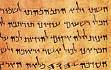
The Hebrews began, early after the invention of parchment, to write their scriptures on this material, of which the rolls of the law used in their synagogues are still composed.
Scriptural, like many other classes of MSS. originating previous to the eighth century and ink written either on parchment or vellum, or both, are in capital letters without spaces between words and exceedingly rare. The more important and valuable of them which apply to the New Testament are respectively known as the Sinaitic, the Vatican and the Alexandrian, many of whose various translations and readings are incorporated by Tischendorf in his Leipzig edition of the English New Testament. The stories relating to the discovery and obtaining of these relics of the first centuries of our era are startling ones. The reputation and standing, however, of the discoverers, and the investigations subsequently made by known scholars of their time, serves to invest them with a certain degree of truthfulness. The most interesting is the story about the Sinaitic codex, the oldest of any extant and which is best told by Madan:
“The story of the discovery of this famous manuscript of the Bible in Greek, the oldest existing of all the New Testament codexes, and in several points the most interesting, reads like a romance. Constantine Tischendorf, the well-known editor of the Greek Testament, started on his first mission litteraire in April, 1844, and in the next month found himself at the Convent of St. Catherine, at the foot of Mount Sinai. There, in the middle of the hall, as he crossed it, he saw a basket full of old parchment leaves on their way to the burning, and was told that two baskets had already gone! Looking at the leaves more closely, he perceived that they were parts of the Old Testament in Greek, written in an extremely old handwriting. He was allowed to take away forty-three leaves; but the interest of the monks was aroused, and they both stopped the burning, and also refused to part with any more of the precious fragments. Tischendorf departed, deposited the forty-three leaves in the Leipsig Library, and edited them under the title of the Codex Friderico-Au-gustanus, in compliment to the King of Saxony, in 1846. But he wisely kept the secret of their provenance, and no one followed in his track until he himself went on a second quest to the monastery in 1853. In that year he could find no traces whatever of the remains of the MSS. except a few fragments of Genesis, and returned unsuccessful and disheartened. At last, he once more took a journey to the monastery, under the patronage of the Russian Emperor, who was popular throughout the East as the protector of the Oriental Churches. Nothing could he find, however; and he had ordered his Bedouins to get ready for departure, when, happening to have taken a walk with the steward of the house, and to be invited into his room, in the course of conversation the steward said: ‘I, too, have read a Septuagint,’ and produced out of a wrapper of red cloth, ‘a bulky kind of volume,’ which turned out to be the whole of the New Testament, with the Greek text of the Epistle of Barnabas, much of which was hitherto unknown, and the greater part of the Old Testament, all parts of the very MSS. which had so long been sought! In a careless tone Tischendorf asked if he might have it in his room for further inspection, and that night (February 4-5, 1859) it ‘seemed impiety to sleep.’ By the next morning the Epistle of Barnabas was copied out, and a course of action was settled. Might he carry the volume to Cairo to transcribe? Yes, if the Prior’s leave was obtained; but, unluckily the Prior had already started to Cairo on his way to Constantinople. By the activity of Tischendorf he was caught up at Cairo, gave the requisite permission, and a Bedonin was sent to the convent, and returned with the book in nine days. On the 24th of February, Tischendorf began to transcribe it; and when it was done, conceived the happy idea of asking for the volume as a gift to the Emperor of Russia. Probably this was the only possible plea which would have gained the main object in view, and even as it was there was great delay; but at last, on the 28th of September, the gift was formally made, and the MSS. soon after deposited in St. Petersburg, where it now lies. The date of this MSS. is supposed to be not later than A. D. 400, and has been the subject of minute inquiry in consequence of the curious statement of Simonides in 1862, that he had himself written it on Mount Athos in 1839-40.”
Constantine Simonides was a Greek who was born in 1824 and is believed to have been the most versatile forger of the nineteenth century. From 1843 until 1856 he was in evidence all over Europe offering for sale fraudulent MSS. purporting to be of ancient origin.
In 1861 Madan says:
“He boldly asserted that he himself had written the whole of the Codex Sinaiticus which Tischendorf had bought in 1856 from the monastery of St. Catherine on Mount Sinai. The statement was, of course, received with the utmost incredulity; but Simionides asserted, not only that he had written it, but that, in view of the probable skepticism of the scholars, he had placed certain private signs on particular leaves of the codex. When pressed to specify these marks he gave a list of the leaves on which were to be found his initials or other monogram. The test was a fair one, and the MSS., which was at St. Petersburg, was carefully inspected. Every leaf designated by Simonides was found to be imperfect at the part where the mark was to have been found. Deliberate mutilation by an enemy, said his friends. But many thought that the wily Greek had acquired through private friends a note of some imperfect leaves in the MSS., and had made unscrupulous use of the information.”
A curious kind of document, which links the classical times with the middle ages, in respect to the we of parchment, is afforded by the “palimpsests,” or manuscripts from which old writing had been erased in order to make way for new. A well-prepared leaf of parchment was so costly an article in the middle ages, that the transcribers who were employed by the monastic establishments in writing often availed themselves of some old manuscript, from which they scraped off the writing; such a doubly-used piece of parchment was called a “palimpsest.” This practice seems to have been followed long before, but not to so great an extent as about the fourteenth and fifteenth centuries, at which time there were persons regularly employed as “parchment-restorers.” The transcribers had a regular kind of knife, with which they scratched out the old writing, and they rubbed the surface with powdered pumice stone, to prepare it for receiving the new ink. So common was this practice that when one of the emperors of Germany established the office of imperial notary, it was one of the articles or conditions attached to the holding of the office that the notary should not use “scraped vellum” in drawing deeds. Sometimes the original writing, by a careful treatment of the parchment, has been so far restored as to be visible, and it is found to be parallel, diagonal, and sometimes at right angles to the writing afterwards introduced. In many cases the ancient writing restored beneath is found to be infinitely more valuable than the monkish legends written afterwards.
Cicero’s De Republica was discovered by Angelo Mai in the Vatican library written under a commentary of St. Augustine on the Psalms; and the Institutions of Gains, in the library of the chapter of Verona, were deciphered in like manner under the works of St. Jerome.
Papyrus, parchment, and vellum were sometimes used together in the MSS. books. Thompson, author of “Greek and Latin Palaeography,” observes:
“Examples, made up in book form, sometimes with a few vellum leaves incorporated to give stability, are found in different libraries of Europe. They are: The Homilies of St. Avitus, of the 6th century, at Paris; Sermons and Epistles of St. Augustine, of the 6th or 7th century, at Paris and Genoa; works of Hilary, of the 6th century, at Vienna; fragments of the Digests, of the 6th century, at Pommersfeld; the Antiquities of Josephus, of the 7th century, at Milan; an Isidore, of the 7th century, at St. Gall. At Munich, also, is the register of the Church of Ravenna, written on this material in the 10th century.”
The rolls and records connected with the early parliamentary and legal proceedings in England furnish interesting examples of the use of parchment in writing. The “Records,” so often alluded to in such matters, are statements or details, written upon rolls of parchment, of the proceedings in those higher courts of law which are distinguished as “Courts of Record.” It has been stated that “our stores of public records are justly reckoned to excel in age, beauty, correctness, and authority whatever the choicest archives abroad can boast of the like sort.”
The records are generally made of several skins or sheets of parchment or vellum, each sheet being about three feet long and often nine to fourteen inches in width. They are either all fastened together at one end, so as to form a kind of book, or are stitched end to end, so as to constitute an extended roll. These two methods appear each to have had its particular advantages, according to the way in which, and the time at which, the manuscript was filled up. Some of the records of the former of these two kinds contain so many skins of parchment that they form a huge roll equal in size to a large bass drum, and requiring the strength of two men to lift them. Some of these on the continuous plan are also said to be of immense size; one, of modern date, is nine hundred feet in length and employs a man three hours to unroll it. The invaluable old record, known by the name of “Doomsday Book,” is shaped like a book, and is much more convenient to open than most of the others. Various other legal documents, to an immense amount, are “filed,” or fastened together by a string passing through them.
It seems a very strange contradiction, but it is positively asserted as a fact, that the parchment employed for these records was of very fine quality down to the time of Elizabeth, but that it gradually deteriorated afterwards, insomuch that the latest are the worst. Some of these records and rolls are written in Latin, some in Norman French, and some in English.
The modes of depositing and carrying the ancient records were curious, and there seems to have been no very definite arrangement in this respect. Great numbers were kept in pouches or bags made of leather, canvas, cordovan, or buckram; they were tied like modern reticules. When such pouches have escaped damp they have preserved the parchment records for centuries perfectly clean and uninjured. Another kind of receptacle for records was a small turned box, called a “skippet,” and another was the “hanaper,” or hamper, a basket made of twigs or wicker-work. Chests, coffers, and cases of various shapes and sizes formed other receptacles for the records. The mode of finding the particular document required was not by a system of paging and an index, as in a modern book, because the arrangement of the written sheets did not admit of this, but there were letters, signs, and inscriptions, or labels for this purpose; they constitute an odd assemblage, comprising ships, scales, balances, castles, plants, animals, etc.; in most instances the signs or symbols bear some analogy, or supposed analogy, with the subject of the record, such as an oak on a record relating to the forest laws, a head in a cowl on one relating to a monastery, scales on one relating to coining, etc.
At a time when books were prepared by hand instead of by printing, and when each copy became very valuable, books were treated with a degree of respect which can be hardly understood at the present day. The clergy and the monks were almost exclusively the readers of those days, and they held the other classes of society in such contempt, in all that regarded literature and learning, that Bishop de Burg, who wrote about five centuries ago, expresses an opinion that “Laymen, to whom it matters not whether they look at a book turned wrong side upwards or spread before them in natural order, are altogether unworthy of any communion with books.”
It is stated by Mr. Knight, in his “Life of Caxton:”
“We have abundant evidence, whatever be the scarcity of books as compared with the growth of scholarship, that the ecclesiastics laboured most diligently to multiply books for their own establishments. In every great abbey there was a room called the Scriptorium, where boys and novices were constantly employed in multiplying the service-books of the choir, and the less valuable books for the library; whilst the monks themselves laboured in their cells upon bibles and missals. Equal pains were taken in providing books for those who received a liberal education in collegiate establishments.”
Warton says:
“At the foundation of Winchester College, one or more transcribers were hired and employed by the founder to make books for the library. They transcribed and took their food within the college, as appears by computation of expenses on their account now remaining. But there are many indications that even kings and nobles had not the advantage of scholars by profession, and, possessing few books of their own, had sometimes to borrow of their more favoured subjects.”
We learn from another source that the great not only procured books by purchase, but employed transcribers to make them for their libraries. The manuscript expense account of Sir John Howard, afterwards Duke of Norfolk, shows in 1467, Thomas Lympnor, that is Thomas the Limner of Bury, was paid the sum of fifty shillings and two pence for a book which he had transcribed and ornamented, including the vellum and binding. The limner’s bill is made up of a number of items, “for whole vignettes, and half-vignettes, and capital letters, and flourishing and plain writing.”
These transcribers and limners worked principally upon parchment and vellum, for the use of paper was by no means extensive until the invention of the art of printing. Some of the old manuscripts contain drawings representing a copier or transcriber at work, where the monk is represented as provided with a singular and tolerably complete set of apparatus to aid him in his work. The desk for containing the sheet or skin on which he is writing, the clasp to keep this sheet flat, the inkstand, the pen, and the knife, the manuscript from which the copy is being made, the desk for containing that manuscript, and the weight for keeping it in its place,--all are shown, with a clearness which, despite of bad perspective, renders them quite intelligible.
Of the two substances, parchment and vellum, before the invention of paper, another word or two may be said. Parchment is made from the skin of sheep or lambs; vellum, from that of very young calves (sometimes unborn ones), but the process of preparing is pretty much the same in both cases. When the hair or wool has been removed, the skin is steeped in lime water, and then stretched on a square frame in a light manner. While so stretched, it is scraped on the flesh side with a blunt iron, wetted with a moist rag, covered with pounded chalk, and rubbed well with pumice stone. After a time, these operations are repeated, but without the use of chalk; the skin is then turned, and scraped on the hair side once only; the flesh side is then scraped once more, and again rubbed over with chalk, which is brushed off with a piece of lambskin retaining the wool. All this is done by the skinner, who allows the skin to dry on a frame, and then cuts it out and sends it to the parchment maker, who repeats the operation with a sharper tool, using a sack stuffed with flocks (wool or hair) to lay the skin upon, instead of stretching it on a frame.
Respecting the quality, value, and preparation of parchment in past ages, it is stated in the “Penny Cyclopaedia” that parchment from the seventh to the tenth century was “white and good, and at the earliest of these periods it appears to have nearly superseded papyrus, which was brittle and more perishable. A very few books of the seventh century have leaves of parchment and papyrus mixed, that the former costly material might strengthen and support the friable paper. About the eleventh century it grew worse, and a dirty colored parchment is evidence of a want of antiquity. This may possibly arise from the circumstances that writers of this time prepared their own parchment, and they were probably not so skilled as manufacturers. A curious passage from a sermon of Hildebert, Archbishop of Tours, who was born in 1054, is a voucher for this fact. The sermon is on the “Book of Life,” which he recommends his hearers to obtain:
‘Do you know what a writer does? He first cleanses his parchment from the grease, and takes off the principal part of the dirt; then he entirely rubs off the hair and fibres with pumice stone; if he did not do so, the letters written upon it would not be good, nor would they last long. He then rules lines that the writing may be straight. All these things you ought to do, if you wish to possess the book which I have been displaying to you.’
At this time parchment was a very costly material. We find it mentioned that Gui, Count of Nevers, having sent a valuable present of plate to the Chartreux of Paris, the unostentatious monks returned it with a request that he would send them parchment instead.”
Copyright © D. J. McAdam· All Rights Reserved